More Than One Family Member Seeing the Same Therapist
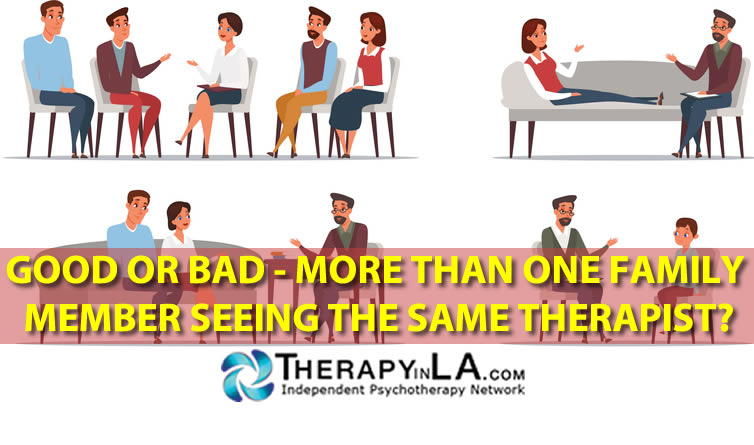
GOOD OR BAD – More than ONE FAMILY Fellow member SEEING THE Aforementioned THERAPIST?
by Malcolm Miller, Ph.D.
With all the concerns about the COVID 19 virus, more individuals, couples and families will perhaps be entering therapy. The reality of these fears and the changes in lifestyle due to habitation sheltering, task losses, and economic impact may bring more than longstanding issues to the surface. The question of the aforementioned or split therapists will likely arise. Below are some points to ponder.
First, let me exist clear that I am not referring to family members involved in couple, parent-child, or family unit therapy sessions. In those situations, of grade, the therapist sees members of the same family unit, usually at the same time.
This discussion centers on whether different forms of therapy should occur with the same therapist with members of the aforementioned family unit. For example, should a therapist be seeing i partner in individual therapy and also be treating both partners in couples therapy? Should the same therapist be seeing a h the parent and child in their own individual therapies? You lot and the other family members, in consultation with the therapist, demand to examine your own thoughts and feelings about yourself, the needs of other members of your family, and the capabilities of the particular therapist for multiple therapies.
Points in Favor
- Less repetition and confusion.
Having the same therapist means that history, current circumstances and various data practise not need to be fully repeated. This saves on time and energy repeating data, and reduces the number of sessions. Savings issue in the cost of therapy. Also, if at that place are inconsistencies amid family members, these will be more than quickly and conspicuously noted when the therapist is the same person.
- There is greater congruity.
Therapists accept dissimilar theoretical orientations, styles, and personalities. Although these differences can be valuable, in combination they may pb to contradictions. The family members, incorporating what they have learned, may exist coming from very different perspectives, and therefore, be dislocated and unsure of how all-time to apply what they learn from therapy.
An example would be one therapist recommending exploring the private'due south or family's historical pattern of dealing with stress, while the other therapist is recommending a problem-solving effort. If there are family unit sessions and private sessions discussing parent/child issues, one therapist could come from a more firm perspective and the other from a more "give and take" perspective, also resulting in confusion and frustration. Seeing just one therapist prevents these situations from occurring.
Furthermore, although the therapist is committed to the needs of whomever he is meeting with at the fourth dimension, the overall treatment can fit more similar a mosaic, with the same therapist, rather than a combination of carve up pieces , as can occur with multiple therapists. For example, there accept been times when I have seen a husband and wife individually to focus on their individual issues in addition to couple sessions. Each felt that, although I was focused on their individual needs, I was attuned to their want that solutions ultimately needed to exist congruent and in the involvement of both.
- In that location can be greater trust.
If the commencement customer in treatment trusts the capability of the therapist, he will be more than trusting of the competency of the therapist coming together later with another family unit member. Similarly if a member of the family has liked the work the therapist did with another member of the family unit, he may feel less uneasy going to the same therapist.
A specific instance involved my seeing a hubby who was having difficulties with career issues. The wife felt positive most the aid I had provided him, and she wanted me to help with issues she had with her mother and felt confident in my abilities. Subsequently they both returned to me for assistance with their human relationship.
Although information technology would be simpler if nosotros left it hither, there are some very serious cautions that need to be evaluated. A critical factor that enabled the higher up therapies to be successful was the fact that the clients and I thoroughly explored the post-obit points against.
Points Confronting
- Trust–questioning whether the therapist has the client's interests in the forefront.
In successful therapy clients need to experience bodacious that the therapist has their needs every bit primary. Clients have dissimilar levels of trust and security. Some clients are quite apprehensive that, if the therapist is coming together with some other member of the family, the therapist will be incorrectly influenced in favor of the other family unit fellow member. In this situation, the client'south significant trust concerns volition likely lead to a recommendation for dissever therapists.
- Confidentiality concerns–worry that private information will be revealed, even by honest mistake, with some other member of the family.
For example, a client may discuss a trauma he experienced every bit a kid. The client is non withal fix to discuss this with their partner and may be afraid the therapist might inadvertently share this data in a couples session. If this is a significant business, information technology must be honored and dissimilar therapists are best.
- Differences in personalities and fashion.
A therapist who is very successful with ane member of a family may non be with another. Also some therapists are better with one mode of therapy, such every bit individual, and another therapist may have more skills working with families, etc.
- Problems in therapeutic neutrality.
This is a very critical and catchy issue that can potentially compromise the therapy. A couple of examples will clarify this indicate. If the therapist is seeing both the couple and one or more members of that couple individually, the therapist needs to be able to express or interpret what is best for the client. In couple therapy, the client is the couple; in private therapy, the client is that particular individual. Sometimes what is best for the private may not be in the best interest of the continuing couple relationship and vice-versa. For example, permit united states of america say the shared goal of couple therapy is to work out differences and continue the relationship. In the individual therapy, it becomes clear to the therapist that this human relationship may exist harmful to the client, repeating bug from the past that are subversive to the private. The therapist needs to feel he tin explore this result in the individual therapy to best meet the needs of his client–in this instance the individual. This may very well be in disharmonize with the goals of the couple therapy, and the therapist needs to exist honest in both therapies. If the therapist is seeing both the individual and the couple, he may cease upwards doing an bogus juggling act. Information technology is best if this possibility can be avoided at the beginning of treatment. I therefore recommend to new couple clients that we have dual goals of assessing whether the problems tin can indeed exist worked out to meet both of these needs, and, if they can, to work on ways to achieve this. A few preliminary sessions might be needed to develop a plan to get forrad.
- The therapist keeping secrets.
Although this issue relates to the terminal point on therapist neutrality, it deserves its own department. This concerns the therapist being placed, or placing himself, in the position of keeping a critical relationship upshot a secret from the other fellow member of the family in treatment. An example of this would be a customer revealing the plan to end the relationship at some point in individual therapy and not wanting it raised in couple therapy. If the therapist were to agree to this, it would clearly compromise the therapist'south neutrality in couple therapy, since he is colluding in keeping a secret from the partner.
Responsible therapists endeavour their best to avoid this from the commencement past discussing in depth with clients the impairment of relational secrets to the couple therapy and the disquisitional importance of the therapist existence able to maintain neutrality to best help them.
Last Thoughts
I promise that this commodity has raised your awareness and understanding of this result. I encourage y'all to hash out your questions, should they ascend, in therapy to aid avoid the potential pitfalls.
I began writing this article planning on taking a neutral perspective. As I continued writing the "Points in Favor" and the "Points Against", I felt the points against were actually much stronger. You and other family members tin sign releases for the therapists to consult. This can reduce the conflicts of having more than ane therapist working with different family members.
Dr. Malcolm Miller is a Clinical Psychologist practicing in West Los Angeles and Torrance, and he is a fellow member of the Contained Psychotherapy Network. He may be contacted at (310) 822-8898 or mmillerphd@aol.com.
Copyright 2020 by Malcolm Miller, Ph.D.
Source: https://therapyinla.com/one-family-member-seeing-same-therapist/
0 Response to "More Than One Family Member Seeing the Same Therapist"
Post a Comment